
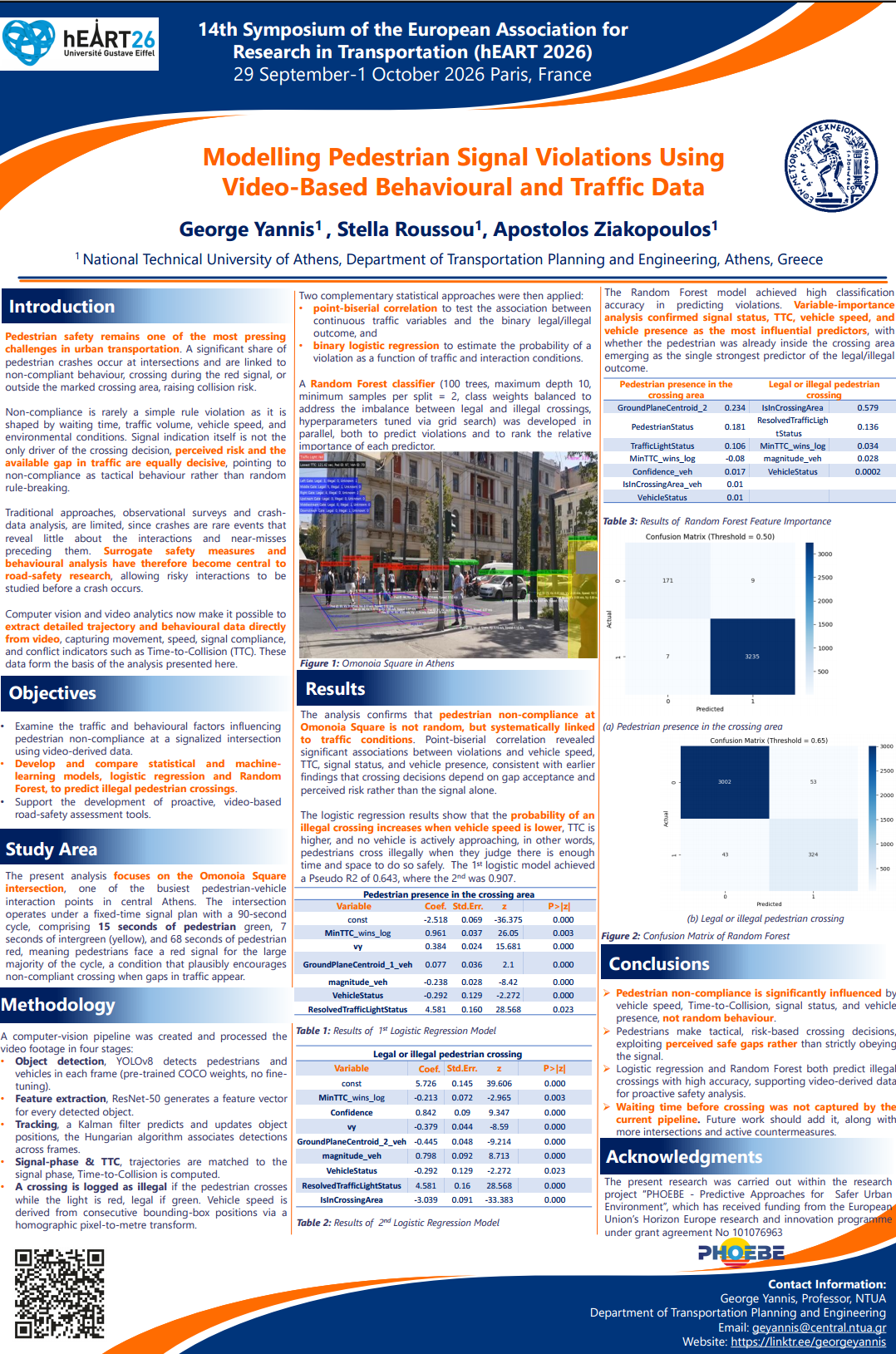
Pedestrian non-compliance at signalized intersections is a major safety concern in urban areas, particularly in locations with high pedestrian demand and complex traffic conditions. This study investigates the factors influencing pedestrian signal violations using video-based data collected at a signalized intersection in Athens, Greece. Pedestrian trajectories, vehicle trajectories, signal status, and interaction variables were extracted using a computer vision pipeline. Statistical analysis, including point-biserial correlation, binary logistic regression, and Random Forest classification, was applied to examine the relationship between traffic conditions and pedestrian compliance behaviour and to predict illegal crossings. The results indicate that pedestrian violations are strongly associated with traffic conditions such as vehicle speed, Time-to-Collision (TTC), signal phase, and vehicle presence. The predictive models achieved high classification accuracy, indicating that pedestrian non-compliance is not random but influenced by observable traffic and interaction conditions. The findings support proactive road safety analysis and the development of predictive safety assessment tools.
| ID | pc698 |
| Presentation | |
| Full Text | |
| Tags |