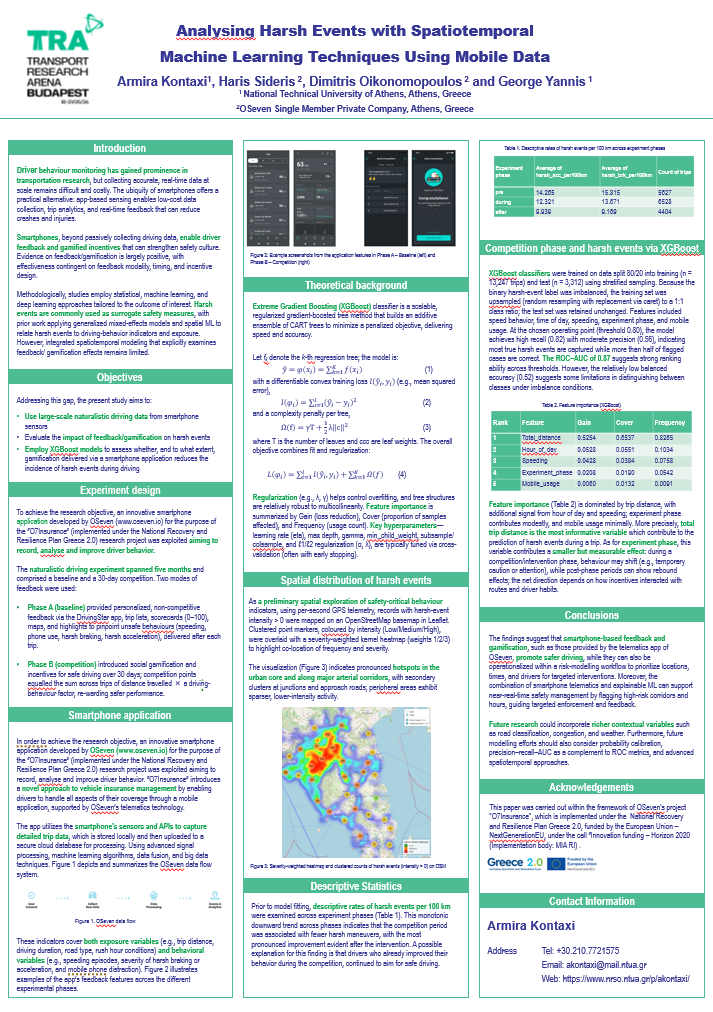
The proliferation of smartphone-based telematics has enabled scalable, high-resolution monitoring of driving behaviour across space and time. In that framework, the aim of this study is to investigate harsh driving events using large-scale smartphone telematics collected during a five-month naturalistic experiment that included a 30-day gamified competition embedded within baseline operation. From a cohort of 95 drivers that participated in the competition, per-second GPS traces were used to map severity-weighted hotspots, and trip-level metadata supported machine-learning analysis of different phase effects. An Extreme Gradient Boosting (XGBoost) machine learning classifier was trained with an 80/20 stratified split (13,247 training, 3,312 test trips) and minority-class upsampling. Feature importance was dominated by distance, followed by hour of day and speeding; experiment phase showed a smaller but measurable contribution, and mobile usage was minimal. Spatial visualization revealed pronounced hotspots along urban cores and major corridors. These findings suggest that smartphone-based feedback and gamification, such as those provided by the telematics app of OSeven, promote safer driving, while they can also be operationalized within a risk-modelling workflow to prioritize locations, times, and drivers for targeted interventions.
| ID | pc649 |
| Presentation | |
| Full Text | |
| Tags |