Month: February 2014
The Road Safety Unit of DG Move of the European Commission is constantly updating its statistics website, with rich and easy to consult information on the latest trends on road safety in the European Union. Visitors of this website can find updated trends of road fatalities, several detailed road safety maps with specialinteractive tools, charts and figures, as well as several comprehensive basic fact sheets with data on key road safety issues. These data are easily available and very useful for all road safety decision makers and other stakeholders in Europe. 
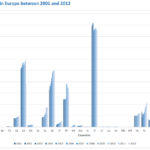
The Motorcycle Industry in Europe (ACEM) has just released data on power-two-wheelers (PTW) deliveries and registrations, circulating park, production and best sold models in a panel of European countries (data available as of January 2013). These tables and figures highlight the significant decrease in new PTW vehicles in most European countries since the beginning of the economic crisis. 
A paper titled ‘Assessment of exposure proxies for macroscopic road safety prediction‘ co-authored by Costas Antoniou and George Yannis is now published in Transportation Research Record. The objective of this research is to investigate the suitability of alternative proxy variables for macroscopic road safety modeling, using three suitable exposure proxies: (i) number of vehicles in circulation, (ii) GDP and (iii) fuel consumption. Severalstructural time-series models have been developed for each proxy for two Mediterranean countries with many similar socio-economic characteristics: Greece and Cyprus. Based on the findings of this analysis, a number of observations can be drawn. Proxy variables can provide reasonable results, when exposure data are not available. Furthermore, even in two countries with many similarities the selected proxy measure differs. This suggests that the underlying conditions that make a variable a suitable proxy for exposure is complex and needs further investigation. 
The RIDERSCAN project is a EU co-funded project, coordinated by the Federation of European Motorcyclists’ Associations (FEMA), aiming to gather existing information on motorcycle safety in Europe, to identify needs for action and to create a crossborder knowledge-based network. NTUA contributes to the various actions of the RIDERSCAN project as an activity partner.
RIDERSCAN launched the 3rd and last survey targeting European motorcyclists. With the objective to draw a European map of rider awareness and acceptance of new technologies applied to the transport systems, the survey is asking riders to evaluate willingness to test, use, and buy systems, which are, for a wide majority of them, far from being introduced in the market. Motorcycle riders and stakeholders are invited to fill in this on-line survey, (in less than 15 minutes), available in several European languages: English and Greek .
and Greek .

An event on “Child and Road Safety” is organised by the Ministry of Infrastructure, Transport and Networks under the Greek Presidency, which will take place on 5 March 2014, in Athens, at the Ministry Auditorium, on the occasion of the official release of children’s road safety educational book ‘My friend the bike’ and children’s song ‘Mind-Warning’.

The World Health Organisation (WHO) has launched a new tool to support development of strong road safety campaigns. This new resource for Governments and civil society organizations, is a part of the Bloomberg Philanthropies Global Road Safety Programme. The library, which contains some of the world’s most impactful road safety video and audio campaigns, is intended as inspiration for those planning to produce their own campaigns by offering a range of creative ideas and concepts. The library is searchable by topic (drinking and driving, motorcycle helmets, and seat-belts, language, etc) or WHO region (currently includes around 60 campaigns).