Month: September 2020

The Institute of Communication & Computer Systems within the EU funded Horizon 2020 project L3Pilot organised a Summer School titled “Developing and Testing Automated Driving“, which was held on-line with great success, on 9-10 September 2020. The L3Pilot Summer School 2020 focused on the theory and practice of Automated Driving Implementation and Testing and in particular on the progress of the largest European pilot-testing of SAE Level 3 driving functions implemented by L3Pilot partners.  NTUA actively contributed with the following presentation:
  A methodological framework from data collection to impact assessment of autonomous vehicles
NTUA actively contributed with the following presentation: A methodological framework from data collection to impact assessment of autonomous vehicles
The IEEE Intelligent Transportation Systems Society (ITSS) organised the 23rd IEEE International Conference on Intelligent Transportation Systems (ITSC) which was held on-line, on 20-23 September 2020. The conference focused on new developments in theory, analysis, simulation and modeling, experimentation, demonstration, case studies, field operational tests, and deployments.
NTUA actively contributed with the following paper and presentation:  Impacts of Autonomous Shuttle Services on Traffic, Safety and Environment for Future Mobility Scenarios
NTUA actively contributed with the following paper and presentation: Impacts of Autonomous Shuttle Services on Traffic, Safety and Environment for Future Mobility Scenarios
In the framework of the European Mobility Week, the ROADPOL Safety Days (formerly known as Project EDWARD) took place on 16-22 September, in Mainz, Germany. The aim of the ROADPOL Safety Days was to reduce the number of traffic fatalities, which is 70 per day across Europe, to zero at least in one day. Activities varied from additional roadside checks to awareness-raising initiatives, such as vehicle turnover simulations, exhibitions and debates.

The SHOW (SHared automation Operating models for Worldwide adoption) project organised its 1st Pan-European Workshop, titled «How to make CCAM in Cities a reality» which was held on-line on 18 September 2020. In this workshop, a selection of high-level keynote speakers shared their views and experiences about Connected and Cooperative Automated Mobility, while interactive sessions about Use Cases for CCAV in Urban Mobility and Best Practices for Business and Operating Models in Europe and worldwide took place.
A paper titled “Meta-regressions of exposure parameters used in spatial road safety analyses, September 2020” authored by Apostolis Ziakopoulos, and George Yannis, is now published in Advances in Transportation Studies. The objective of this paper is to obtain quantitative estimates that several study characteristics impose on the values of their coefficients applying meta-regression techniques to three common exposure parameters (traffic volume/AADT, roadway length and vehicle distance traveled). Results indicate that the impact of traffic volume on crash counts was positively correlated with taking speed limit and road user age into consideration in spatial analyses, while the impact of road length on crash counts in spatial analyses was found to be higher in studies considering only fatal crashes. 
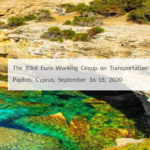
KIOS Research and Innovation Center of Excellence (KIOS CoE) of University of Cyprus organized the 23rd EURO Working Group on Transportation EWGT 2020 which took place with great success in Paphos, Cyprus, on 16-18 September 2020. The sessions focused on various themes including advanced methodologies for road safety analyses. NTUA actively contributed with the following paper and presentation: European Countries’ Road Safety Evaluation by Τaking Ιnto Account Multiple Classes of Fatalities
NTUA actively contributed with the following paper and presentation: European Countries’ Road Safety Evaluation by Τaking Ιnto Account Multiple Classes of Fatalities
ActTravelWise orginised a webinar titled “The Emergency Active Travel Fund: Plans and Implementation at the Local Level” which was held with great success on 14 September 2020. Authorities who received funding under the Emergency Active Travel Fund, shared their plans and how they intend to implement them on the ground to benefit local residents. Athens took the opportunity to introduce a step-change in active travel infrastructure. Lastly, a panel discussion took place, with the opportunity for other local authorities to share their plans and any issues or challenges. Presenters: George Yannis, Laura Wells, Ambrose White, Lynsey McGarvey, and Sian Fox. NTUA actively contributed with the following presentation: Athens Great Walk transformation project
NTUA actively contributed with the following presentation: Athens Great Walk transformation project
The Slovenian Traffic Safety Agency organized the periodical training course for Road Safety Auditors which took place with great success on September 14-16, 2020 in Ljubljana, Slovenia.
NTUA actively contributed with the following lecture: Innovations in Road Safety Audit practices in the European Union and internationally
Innovations in Road Safety Audit practices in the European Union and internationally
The International Transport Forum (ITF/OECD) published recently a new Report titled “Best Practice for Urban Road Safety”, in which seven case studies of cities that are implementing data-driven road safety policies are presented. It highlights relevant experiences aimed at reducing the number of traffic casualties and protecting vulnerable road users in Barcelona, Bogota, Buenos Aires, Fortaleza, London, New York and Rotterdam and illustrates the diverse approaches to better understand road crashes and to prevent road traffic deaths and serious injuries.
Global Alliance of NGOs for Road Safety organised with great success an online Q&A session with Dr. Etienne Krug, Director of the Department of the Social Determinants of Health, WHO which was held on 22 September 2020. This webinar gave an insight on the new UN General Assembly resolution A/RES/74/299 on improving global road safety answering questions like what the resolution is, why it matters, and how it can help you to advocate for safer roads.
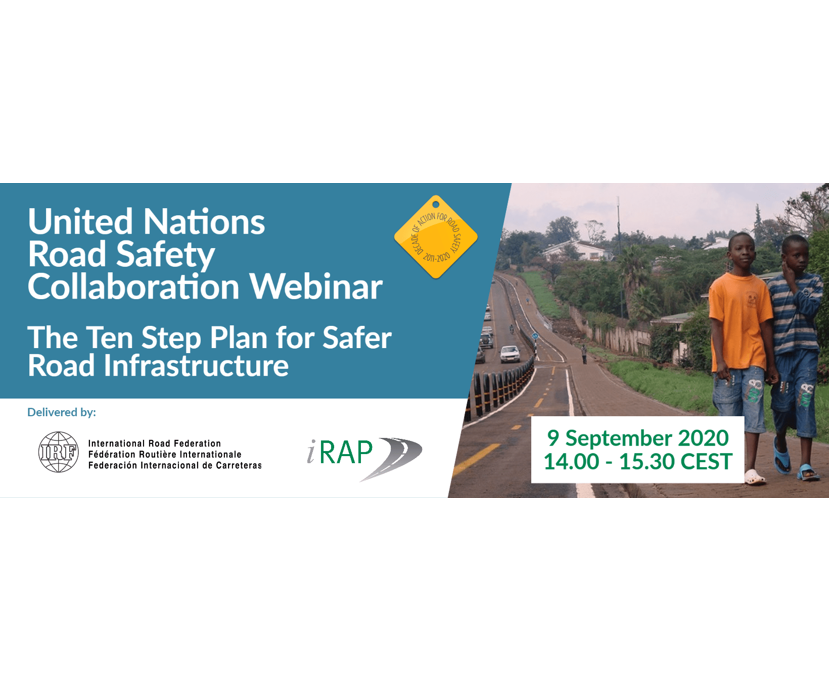
The International Road Federation (IRF) and the International Road Assessment Programme (iRAP) organised a free webinar which was hosted on 9th September at 14:00 under the frame of the United Nations Road Safety Collaboration (UNRSC). The Ten Step Plan for Safer Road infrastructure has been produced by the UNRSC partners to support countries seeking to implement initiatives in relation to the improved safety of road infrastructure and broader transport networks, the UN Convention on Road Traffic and Road Signs and Signals and the achievement of UN Member States Agreed Global Targets 3 and 4 for safer new and existing roads. The webinar provided to the participants the opportunity to learn about the Trust Fund and this new pilot project.
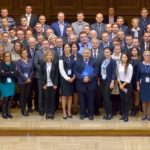
The Department of Highway Engineering of the Gdansk University of Technology and the Foundation for the Development of Civil Engineering in Gdansk organised with great success the 13th International Road Safety Conference GAMBIT 2020. The Conference has held online on 7-8 September 2020 focusing on challenges and requirements of improving road safety until 2030. It covered topics such as challenges and opportunities for implementing Vision Zero, programmes and strategic actions for road safety until 2030, road safety innovation, from science to practice – an overview of road safety research projects, vulnerable road users, new technologies for road safety, road safety in road design guidelines, safe road surfaces, road safety management, safe public transport and urban mobility versus road safety.

The chair of Transportation System Engineering of the Technical University of Munich (TUM) organised the 7th IEEE International Conference on Models and Technologies for Intelligent Transportation Systems (MT-ITS 2021), which was held online on the 16-17 June 2021. More than 80 state-of-the-art papers were presented boosting vivid discussion on future ITS challenges and opportunities. NTUA actively contributed with the following presentations:
NTUA actively contributed with the following presentations:
- Big Data and Artificial Intelligence for Vision Zero Road Fatalities (key note presentation)
- Investigating the acceptance of an environmental transport charging policy. The case of Athens
- Risk scenario designs for driving simulator experiments
- Driving Behavior Safety Levels: Classification and Evaluation
The International Road Federation (IRF), together with Qatar University, Qatar Transportation and Traffic Safety Center, National Traffic Safety Committee of Qatar Government and World Conference on Transport Research Society, organised with great success a Webinar on “Global Trends on the Status of Traffic Safety under the Covid-19 Pandemic”, which was held on 29 September 2020. This webinar aimed to discuss the potential impacts of the current Covid-19 Pandemic and the associated mobility restriction policies on road traffic safety status.
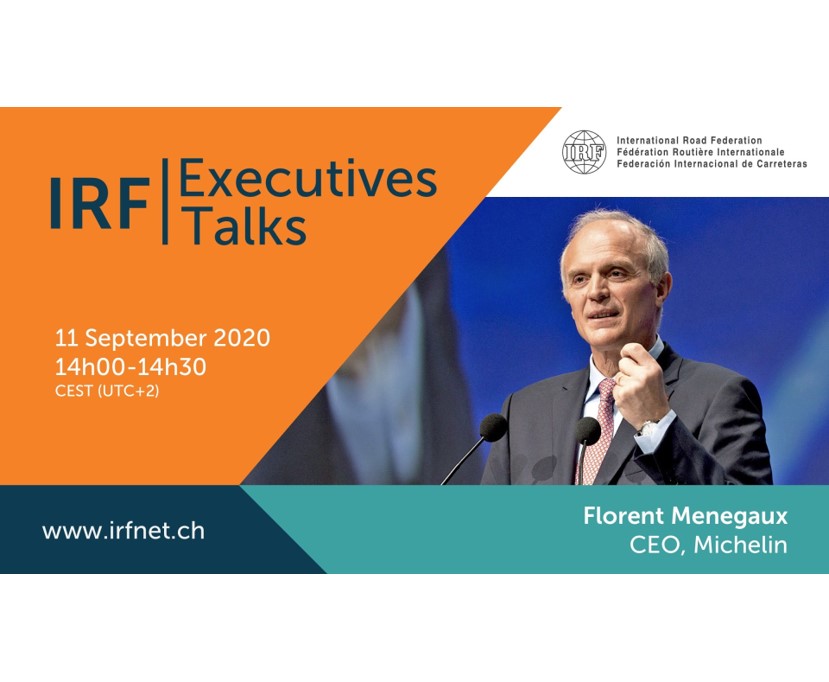
The International Road Federation (IRF) organised with great success the first IRF Executives Talks with Florent Menegaux, CEO, Michelin, which was held online on 11 September 2020. The ‘IRF Executives Talks’ was a series of 30 min talks with high-level executives from the transportation sector highlighting the challenges the sector faces, innovative programmes & ideas and a lot more.
The United Nations Economic and Social Commission for Asia and the Pacific (UNESCAP), the Asian Development Bank (ADB), the World Bank Group, the International Transport Forum (ITF), the Fédération Internationale de l’Automobile (FIA) recently established the Asia Pacific Road Safety Observatory (APRSO), as the Regional Forum on road safety data, policies and practices to ensure the protection of human life on the roads across Asia and the Pacific. Member countries of APRSO are Afghanistan, Azerbaijan, Cambodia, Lao PDR, Kazakhstan and Mongolia.

The UN General Assembly has adopted a new resolution on “Improving global road safety” which was co-sponsored by 55 governments. Among key decisions, the resolution proclaims the period 2021–2030 as the Second Decade of Action for Road Safety, with a goal of reducing road fatalities and injuries by at least 50% from 2021 to 2030, and in this regard calls upon Member States to continue action through 2030 on all the road safety-related targets of the Sustainable Development Goals (SDG). The resolution calls for action to reduce road traffic deaths and injuries as a pressing development priority. It also endorses the Stockholm Declaration, approved at the third Global Ministerial Conference on Road Safety, held in Stockholm on 19 and 20 February 2020.

The 9th conference of European Association for Research in Transportation (hEART) organized by the Transport, Urban Planning and Economics Laboratory (LAET), took place with great success in Lyon on 3-4 February 2021. It covered relevant areas of transportation research with focus on methods, models and planning of transport systems. The aim of the conference was to connect researchers in transport modelling, transport economics, transport engineering and transport policy with advanced practice and state of the art, including road safety applications. NTUA actively contributed with the following paper: Exploring driving behavior as a latent variable in safety modeling. A preliminary analysis from a driving simulator study.