



Road Safety News
Road Safety News concern a selection of the most recent developments on road safety in Greece, in Europe and worldwide.


The European Road Safety Charter of the European Commission recently published two related Articles on Personal Mobility Devices (PMDs), which have rapidly reshaped urban mobility across Europe. More than 80% of fatal e-scooter crashes and around half of serious trauma cases involve a collision with a motor vehicle, while most crashes are actually single-vehicle incidents caused by loss of control, intoxication, distraction or road surface defects. These two Articles recommend improvements to vehicle design (wider wheels, better brakes, lights and indicators), dedicated infrastructure and rider education, while noting that mandatory helmet rules remain a point of debate among experts. Furthermore, several European countries have tightened their e-scooter regulations in 2026, with Greece preparing a comprehensive overhaul. The Greek government has announced plans to ban e-scooter use by minors entirely. Under the proposed legislation, all e-scooters would need speed limiters, mandatory insurance and special identification markings, while access to high-speed roads would be prohibited. Municipalities would also gain the authority to limit the number of shared e-scooters operating within their jurisdictions. 

The International Road Traffic Safety Analysis and Data (IRTAD) Group of the International Transport Forum (ITF) has recently released the updated Road Safety Profile for Greece, demonstrating a historic low in road fatalities. In 2025, Greece recorded 517 road deaths, the lowest number since systematic road crash records began. This is the result of the intensification of enforcement of helmet wearing and drink and drive by the Police, together with the new Road Traffic Code in Greece in force since September 2025, which led to an astonishing improvement of drivers’ behavior. The new Road Traffic Code and related Digital Safety Law introduced major road safety reforms. Passenger car occupants and motorcyclists remain the most affected road user groups, while speeding and drink-driving are identified as the two most critical behavioural risk factors. The profile also describes Greece’s National Road Safety Strategic Plan 2021-2030 aiming to halve the number of road deaths by 2030. 

The International Road Traffic Safety Analysis and Data (IRTAD) Group of the International Transport Forum (ITF) has recently released the updated Road Safety Country Profiles for 2026, a set of individual PDFs providing an overview of road safety performance for each of the countries participating in the IRTAD Group. The country profiles are published separately to the IRTAD Road Safety Annual Report and updated periodically. Each profile covers fatality trends, casualties by road user group and age, crash costs, key behavioural indicators, and national road safety strategy and measures.

The Global Designing Cities Initiative (GDCI) recently released a Handbook titled “How to Implement Cycling Infrastructure“. This Handbook serves as a global resource, and features case studies from the 10 selected BICI cities and other inspiring global best practices, focusing on the full process of implementing cycling infrastructure. Furthermore, it provides resources and frameworks to help cities overcome the most common challenges and build support where they face significant pushback.

A Paper titled “Road users’ safety attitudes towards speeding across 39 countries” authored by Dimitrios Nikolaou, Anna Marie Harkin, Thodoris Garefalakis, George Yannis and Fabian Surges has been published in Accident Analysis & Prevention. This Paper analyses speeding-related behaviours and safety attitudes using the ESRA3 survey, a harmonised international questionnaire administered across 39 countries in 2023. Self-reported speeding behaviours, acceptability beliefs, perceived social norms, risk perceptions, self-efficacy, and support for enforcement and policy measures were examined through descriptive analyses at the regional level and Generalized Linear Mixed Models with random intercepts capturing heterogeneity across all countries. The findings indicate that speeding is widely reported, with younger drivers and males consistently declaring higher speeding frequencies across road types. Driving too fast for road/traffic conditions is reported less often than exceeding limits in built-up areas. Furthermore, GLMM findings show that higher perceived personal/social acceptability is associated with higher self-reported speeding, whereas stronger intentions to comply and greater support for stricter enforcement are associated with lower speeding. These findings support a multifaceted approach combining enforcement, policy, and targeted communication, particularly for younger and male drivers, while accounting for cross-country differences in perceptions and confidence. 


A Paper titled “Improving risky driving behavior classification via conditional GAN-augmented hybrid machine learning models: a two-country naturalistic driving study” authored by Eleni Maria Theodoraki, Paraskevi Koliou and George Yannis has been published in European Transport Research Review. This Paper introduces a hybrid machine learning pipeline that combines Conditional Generative Adversarial Networks (cGANs) for creating realistic synthetic samples with robust classifiers. Furthermore, synthetic minority-class examples were generated with cGANs and combined with real training data. The analysis revealed that augmentation shifted feature importance distributions, reducing speed-metric dominance and increasing the relative importance of distance and physiological features, but whether these shifts reflect genuine generalisation improvements or synthetic data artefacts requires further validation. The results demonstrate how cGAN-based augmentation maintains minority-class detection performance under severe class imbalance while preserving interpretability through SHAP analysis, though further validation on independent driver populations is required before deployment in safety-critical contexts.

A Paper titled “Network-Level Traffic and Safety Effects of Automated Vehicle Market Penetration Under Take-Over Events: A Microsimulation Study” authored by Marios Sekadakis, Dimitrios Nikolaou and George Yannis has been published in Future Transportation. This Paper investigates the network-level traffic and safety effects of increasing Market Penetration Rate (MPR) of SAE Level 2 and Level 3 automated vehicles under take-over conditions. Traffic performance was assessed through five network-level indicators (speed, delay, lane-changing frequency, travel time, and density). Safety was evaluated through 674 conflict events extracted via the Surrogate Safety Assessment Model (SSAM), using Time-to-Collision (TTC) as the primary indicator. MPR is the dominant feature of both dimensions. The findings show that Spearman correlations between MPR and the traffic indicators are very strong for speed, lane changes, travel time, and density, while delay time yields a weaker correlation reflecting its non-monotonic response. Furthermore, traffic costs of mixed-traffic automation appear at partial penetration, while network-level safety benefits remain limited and non-linear.


A Paper titled “Comprehensive Assessment of Driver Takeover Readiness via a Multimodal Fusion Multi-Task Learning Model” has been published in Advanced Engineering Informatics authored by Hanwen Deng, Shuxiang Lin, Chaojie Fan, Xianhui Wu, Kui Wang, Yong Peng and George Yannis. This Paper constructs a multimodal takeover readiness dataset that incorporates visual, physiological, gaze, and demographic features. The dataset was collected from 32 participants using a within-subject design, yielding a total of 20,160 s of synchronized multimodal time-series data. Furthermore, post-trial self-reported questionnaire scores were used as the ground-truth labels for takeover readiness. The experimental results demonstrate that the proposed model effectively fuses multimodal features and captures task-specific representations, achieving an average Accuracy of 79.0%, Balanced Accuracy of 78.5%, and Macro F1 score of 78.2% across five 5-class classification tasks, outperforming the selected baselines. These findings provide insights for the development of more precise and adaptive intervention strategies in future automated driving systems.

A paper titled “Literature review of legal frameworks and liability allocation in connected and automated vehicles” authored by Julia Roussou, Apostolos Ziakopoulos, Armira Kontaxi and George Yannis has been published in Research in Transportation Business & Management. The objective of this Paper is to provide a comprehensive review of current literature in order to identify critical knowledge gaps especially in the design of robust legal frameworks and clarify the impacts of liability allocation regimes on CAVs adoption and operation. By addressing these issues, the paper aims to guide interested stakeholders such as, policymakers, researchers and industry leaders in shaping a transition to automated mobility that is not only safer and more efficient, but is also supported by clear, effective, and trustworthy legal frameworks.

A paper titled “Evaluating Risky Driving Behavior Using a Naturalistic Driving Dataset: A Hybrid Modelling Approach” authored by Elena Maria Theodoraki, Thodoris Garefalakis, Eva Michelaraki and George Yannis has been published in Infrastructures. This Paper develops and evaluates three hybrid machine learning models: (i) Deep Neural Network–Random Forest (DNN-RF), (ii) Convolutional Neural Network–Long Short-Term Memory (CNN-LSTM), and (iii) Recurrent Neural Network–AdaBoost (RNN-AdaBoost), to classify risky driving behavior into three safety levels using naturalistic driving data from Belgium and the UK. The dataset includes 69 drivers, 15,389 trips, and 265,512 min of driving data. Furthermore, feature importance analysis identified harsh acceleration and braking as the most critical factors in Belgium, while total trip distance and harsh acceleration were predominant in the UK. The findings support the potential of hybrid deep learning models in improving road safety by accurately detecting risky driving behaviors. These insights can inform targeted interventions and driver assistance technologies to mitigate crash risks and promote safer driving practices.


A paper titled “Implementation of an integrated model for understanding the impact of task complexity and coping capacity on crash risk” authored by Eva Michelaraki and George Yannis has been published in Accident Analysis & Prevention. This Study aims to identify the interaction of road, vehicle and driver-related factors to the estimation of task complexity, coping capacity and risk. To this end, data from a naturalistic driving experiment involving 135 drivers and 31,954 trips collected over a four-month period were analysed across experimental phases incorporating real-time and post-trip interventions. The results showed that environmental factors, including time of day, weather, distance and duration, were positively associated with task complexity and increased crash risk. Driver-related and vehicle-related state factors influenced coping capacity, which was generally negatively associated with risk. Overall, the Paper highlights the potential of data-driven interventions to improve road safety and support more effective driver assistance systems.


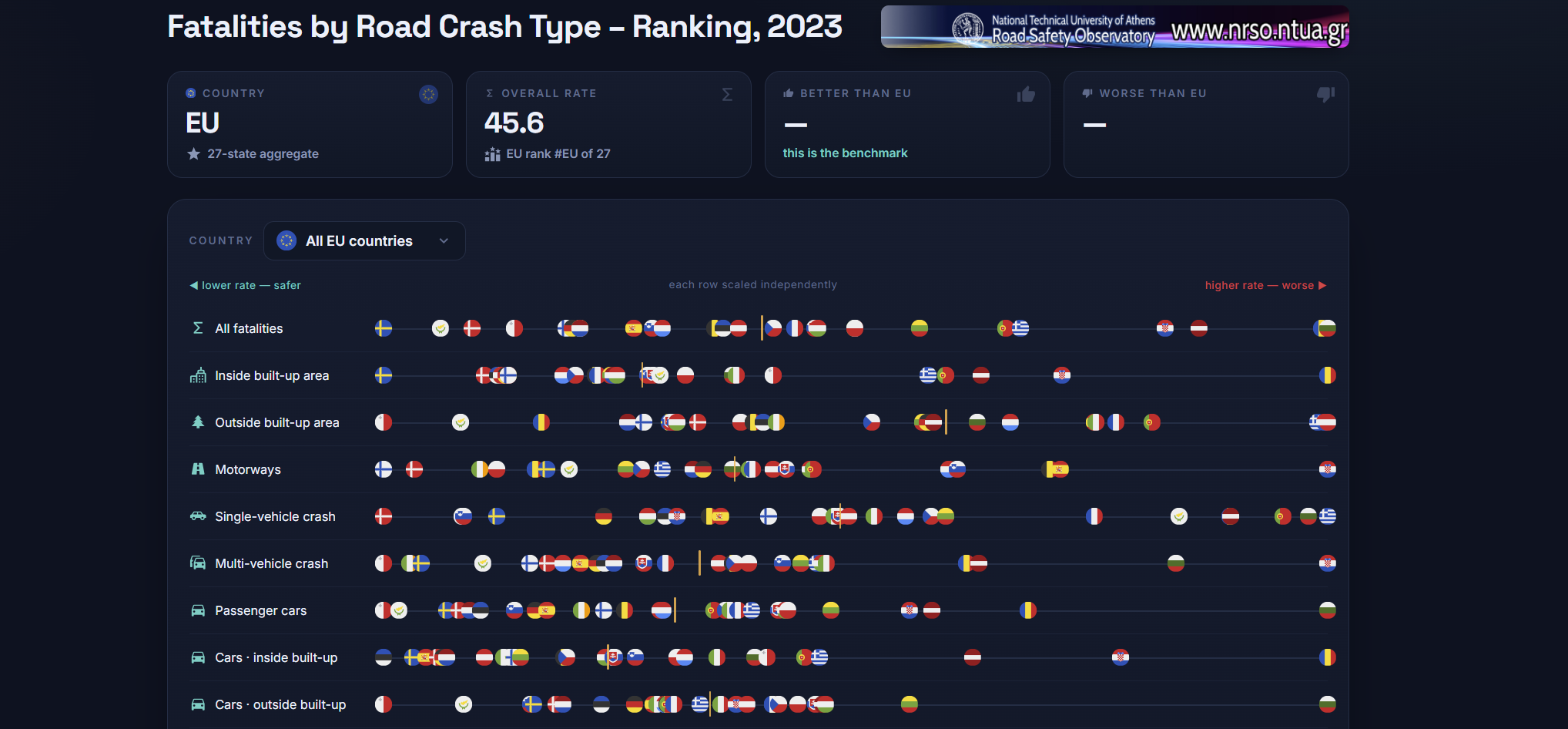
The NTUA Road Safety Observatory (NRSO) has launched its new Road Safety Data Warehouse with highly interactive dashboards, now available and open to all to explore. Thirty interactive dashboards bring together road crash statistics, risk exposure, safety performance indicators, self-reported behaviour and other contextual data, in a comprehensive way for Greece, the European Union and Worldwide. A wide array of data sources was exploited, and concise multi-level data processing was carried out.
For Greece, ten dashboards cover six decades of road crashes and casualties, from long-term trends to the most recent monthly data, broken down by region and type of crash, user, road and vehicle. Further dashboards cover risk exposure, safety performance indicators and self-declared behaviour.
At EU level, eight dashboards exploit CARE data across all EU Member States, comparing overall trends with risk exposure, detailed fatality characteristics, safety performance indicators and self-declared behaviour.
Worldwide, twelve dashboards exploit data from WHO Global Status Reports on Road Safety, covering fatality data, safety performance indicators, other contextual data (national strategy, legislation, infrastructure, vehicle post-crash care) and self-declared behaviour.
All 30 dashboards are regularly updated at the NRSO Data page, as new official data is released.

The Horizon Europe research project IMPROVA has recently released its 4th Newsletter, focusing on enhancing road safety by addressing the complexities of long-term consequences (LTC) caused by road traffic crashes. This version of the Newsletter mainly focuses on the three IMPROVA papers published in Traffic Injury Prevention, as well as the Project’s presence on the upcoming IRCOBI 2026 Conference in Munich. Furthermore, IMPROVA is updating the Functional Capacity Index (FCI), a long-standing reference tool in trauma research and road safety, to better reflect modern injury patterns and clinical insight. Participation to the survey is available here.

The International Road Federation (IRF) released the 63rd edition of the IRF World Road Statistics 2026 (WRS2026), with data open to all for free through the IRF WRS Data Warehouse platform, thanks to the generous support of the TotalEnergies Foundation and Michelin Corporate Foundation. The IRF WRS 2026 continues to be the major comprehensive, universal source of statistical data on road networks, traffic and inland transport, including traffic crashes. This year the WRS 2026 includes the latest data covering years 2019 to 2024, with the active contribution of NTUA for the Greek data. It includes over 200 road and transport-sector related indicators across 11 sections, covering more than 200 countries and territories.

The United Nations and the World Health Organization (WHO) organized with great success a two-day High-Level Meeting on Improving Global Road Safety which was held in New York, on 20-21 July 2026, under the theme “Scaling up and accelerating implementation of commitments to halving road traffic deaths and injuries by 2030“. In this context, the 104th UN General Assembly has adopted the “Progress Declaration on Global Road Safety“, reaffirming the global target of reducing road traffic deaths and injuries by at least 50% by 2030. Furthermore, Governments committed to undertake various actions, such as establishing or designating a national lead agency or equivalent entity to coordinate road safety across government. The Declaration also highlighted the need to ensure that public road transport systems, including bus rapid transit and similar systems, are the safest road transport mode, being also affordable, accessible and inclusive, including for children, older persons and persons with disabilities.

The European Commission, in line with the EU’s General Safety Regulation, recently announced new mandatory life-saving systems for all new passenger cars and vans registered across the EU, starting on 7 July 2026. These new systems include an advanced emergency brake detecting pedestrians and cyclists, a driver distraction warning system, better forward vision, new tests for worn tyres, and an expanded safety glass area to protect pedestrians in accidents. These requirements support the EU’s long-term Vision Zero goal of near-zero road fatalities by 2050, while helping to better protect vulnerable road users and encourage wider adoption of advanced driver-assistance systems.

The Directorate General for Mobility and Transport (DG Move) of the European Commission recently published its implementation strategy for its Directives to modernize EU rules on driving licences and driving disqualifications with the active contribution of NTUA. These initiatives aim to increase road safety across the EU, reducing the number of road deaths as well as undue administrative burden on citizens and authorities. The measures include an EU-wide accompanied driving scheme for 17-year-old drivers, a probationary period for novice drivers, and more systematic checks of people’s fitness to drive. The new rules also adjust training and testing requirements and set out key steps for the introduction of mobile EU driving licences and the EU-wide recognition of driving disqualifications, ensuring drivers who commit serious offences are held accountable across the EU.

The European Road Safety Charter of the European Commission has announced the finalists for its Excellence in Road Safety Awards 2026, as a part of the EU Road Safety Conference which will take place on 23 November 2026 in Brussels, recognizing inspiring initiatives from Charter members across Europe that advance road safety through smart infrastructure, real-time data, immersive training and child-friendly streets. Fifteen finalists were selected across five categories: At Work, Education, Technology, Urban, and Vulnerable Road Users. The winners will be announced at a ceremony during the Event.
European Commission – New Implementing Regulation on Harmonised Urban Mobility Indicators, July 2026

The Directorate General for Mobility and Transport (DG Move) of the European Commission recently adopted an Implementing Regulation establishing a common set of urban mobility indicators to be applied across the European Union. This Implementing Regulation mandates Member States to collect policy-relevant data on urban mobility, helping cities, Member States and EU institutions to monitor developments on the basis of reliable data. It covers key dimensions of urban mobility, including sustainability, safety and accessibility. This adoption marks an important step in strengthening the evidence base for urban mobility policy in the EU. Better data will support better decisions, enabling public authorities at all levels to plan and invest more effectively in sustainable urban transport.

The PHOEBE Decision Support Tool (DST) is now available through the PHOEBE Dashboard. Developed within the Horizon Europe PHOEBE project, the platform enables practitioners, researchers and decision-makers to assess and compare the impacts of road safety interventions using evidence from real-world European pilot cases. Users can explore safety, mobility and environmental performance indicators, Impact Modification Factors (IMFs), and supporting statistical evidence to evaluate different intervention scenarios. The dashboard supports transparent, data-driven decision-making towards safer and more sustainable transport systems.

The United Nations Road Safety Fund (UNRSF), has recently launched the UN Road Safety Lab, a new Knowledge Hub and AI-enabled knowledge platform for road safety. Established in 2018, UNRSF brings together 21 UN member organizations, governments, the World Bank, the private sector and civil society under a single coordinated framework, mobilizing resources and driving system-level road safety reforms in low- and middle-income countries. The new Lab is hosted by the United Nations Institute for Training and Research (UNITAR), the training and capacity-development arm of the UN, and organizes its content across four core areas: Knowledge Products, Platforms of Engagement, Learning, and AI-Enabled Knowledge Solutions, alongside an interactive map showcasing the countries where the Fund is active.

The World Health Organization (WHO) recently released new road death data, showcasing that despite the addition of more than one billion motor-vehicles to the world’s roads, road traffic deaths declined by 21% between 2011 and 2025. With nearly 60% of the world’s population now living in urban areas, growing demand for mobility threatens to overwhelm transport systems that were largely designed around private motor vehicles. This data show that across the world, 10 countries reduced road deaths by 50% in the decade to 2021 and more than half of all countries reported falling fatalities in that period. Yet progress is uneven, with 36% drop in deaths in the WHO European Region, a 15% drop in the Western Pacific Region, a 2% drop in the WHO South-East Asian Region, no change in rates in the Americas and a 17% rise in deaths in the WHO African Region.

The European Road Safety Charter of the European Commission recently published an article titled “Road infrastructure: A foundation for safer roads“, highlighting the critical role of road infrastructure in achieving safer roads. Road design can either support safe behavior or create danger. Many roads encourage high speeds without adequate protection, increasing crash severity. Undivided roads raise head‑on collision risks, unsafe roadsides worsen run‑off crashes, and missing footpaths or crossings leave vulnerable users exposed. To create self-explaining and forgiving roads, six core design principles guide safer infrastructure: provide orientation by making the road environment easy to read and anticipate; attract attention through clear design and signs highlighting hazards; promote standardization with consistent layouts that help users recognize situations; support the detection of potential conflicts through good visibility and guidance at critical points; improve clarity with visible and easy to interpret signs and markings and provide passive safety through forgiving roadsides and designs that reduce injury severity.

A Paper titled “Traffic safety culture within the safe system: developing a common definition of traffic safety culture” authored by Tor-Olav Nævestad, Uta Meesmann, Henriette Wallén Warner, Susanne Kaiser, Ingeborg S. Hesjevoll, Vibeke Milch, Sonja Forward, Mathias De Roeck, Michael Schachner, Dimitris Nikolaou, Gunilla Björklund, Alexandra Laiou, Hanna Wennberg, Eva Aigner-Breuss and Anita Eichhorn was recently published in Frontiers in Sustainable Cities. This study developed the following definition of traffic safety culture, based on a three-step refinement approach, combining literature reviews, Delphi studies and focus group discussions: “Traffic safety culture encompasses shared values, beliefs, attitudes, norms, and patterns of behaviours that shape how traffic safety is understood and enacted within a meaningfully defined group of actors in the transport system. This meaningfully defined group of actors can refer to road users, organizations, authorities, or other actors within the transport system.”

Future Transportation Journal has recently launched the Special Issue titled: “New Challenges in Road Safety Infrastructure Management” aiming to address emerging challenges and propose innovative solutions for enhancing the safety, resilience, and performance of road infrastructure systems. It provides an opportunity to present the latest scientific advances in infrastructure safety assessment, risk analysis, proactive safety management, connected infrastructure, artificial intelligence applications, digital twins, and data-driven decision-support tools for road safety infrastructure management. The manuscript submission deadline is until 28 February 2027. Guest editors of this special issue from NTUA are: Dr. Stergios Mavromatis, Prof. Dr. George Yannis.

The Horizon Europe research project CulturalRoad has recently released the CulturalRoad 4th Newsletter, which provides information on the latest outcomes of the EU-funded CulturalRoad Project aiming to develop innovative methodologies to ensure the equitable deployment of Cooperative, Connected, and Automated Mobility (CCAM) services. This Newsletter highlights the presentation of project’s results & achievements at RTR Conference, Hannover Messe, ITS European Congress and TRA 2026, and the two webinars hosted, one with the sister project Diversify-CCAM focusing on inclusive automated mobility, and a second one with representatives from the project’s five demonstration sites discussing their experience engaging local communities. Furthermore, it introduces new blog posts from the demonstration sites, where partners share more on the co-creation activities and stakeholder workshops.

A Paper titled “Social values behind the wheel: How does social value orientation shape speeding behaviour across drivers in Europe?” authored by Amir Hossein Kalantari, Amna Chaudhry, Mark Burke, Ana María Pérez-Zuriaga, Apostolos Ziakopoulos, Eleonora Papadimitriou, Shanna Lucchesi and Amir Pooyan Afghari was recently published in Transportation Research Part F: Psychology and Behaviour, The Study examined how Social Value Orientation (SVO), a personality trait capturing tendencies toward altruism, cooperation or competitiveness, is associated with drivers’ stated propensity to speed across three European urban contexts, the West Midlands (UK), Athens and Valencia, using Random-Parameters Ordered Probit models with heterogeneity in the means. Results show that road design, traffic density and speed enforcement are associated with self-reported speeding, but these associations vary substantially across contexts and drivers. Furthermore, in the West Midlands, a stronger prosocial orientation weakened the links between behavioral risk constructs and stated speeding, while in Athens the same trait mainly strengthened the association between speeding tendencies and speeding propensity. The study suggests that speed-management strategies may be more effective when physical design and enforcement are paired with communication that presents speed limits as credible, locally relevant and clearly connected to the safety of other road users.

A paper titled Physical Fitness and Highway Driving Performance: Evidence from a Driving Simulator Study of Young Drivers authored by Marios Sekadakis, Theofanis Mitsis, Thodoris Garefalakis and George Yannis has been published in Theoretical and Applied Ergonomics. This Paper investigates the relationship between cardiorespiratory fitness and driving behaviour in a highway environment using a driving simulator, with 46 young drivers aged 19 to 27 classified into high-fitness and low-fitness groups based on estimated maximum oxygen consumption, and each participant completing three simulated highway driving scenarios under varying traffic and lighting conditions. The findings suggest that higher physical fitness is associated with greater adaptability in driving behaviour, reflected in increased headway distance variability and slightly higher driving speeds, while high-fitness drivers also exhibited longer time to collision, suggesting improved anticipation and more effective management of traffic conditions. Moreover, environmental factors, particularly traffic volume and lighting conditions, remained the dominant influences on driving behaviour overall. Overall, the Study highlights the importance of considering health-related factors in road safety research and offers insights for developing preventive strategies targeting young drivers.


A paper titled Crash risk factors in the evolution from conventional to fully automated vehicles in urban environments authored by Maria Oikonomou and George Yannis has been published in Case Studies on Transport Policy. This Paper investigates the evolution of crash risk in urban road networks as the market penetration of Autonomous Vehicles (AVs) increases across different levels of automation, using microscopic traffic simulations in a dense metropolitan area of Athens, Greece. The Study integrates conventional vehicles, partially automated (SAE Level 2-3), fully automated (SAE Level 4-5) and aggressively behaving AVs across 15 progressive deployment scenarios, employing an XGBoost machine learning model combined with SHAP explainability to identify the most influential traffic and behavioural features associated with crash risk. The findings suggest that automation influences crash risk in a way that is neither uniform nor isolated, with fully automated vehicles reducing crash risk as their share grows, while partially automated vehicles slightly increase it in mixed-traffic conditions. Aggressively behaving AVs were found to have minimal impact, mostly at high penetration rates, while traffic density, stop sign-controlled sections and queue length emerged as the most influential factors overall. These findings underscore the need for network-specific planning and offer guidance for AV deployment, infrastructure upgrades and regulatory frameworks to support a safer transition to automated mobility.


The Horizon 2020 research project PHOEBE has recently released the PHOEBE 8th Newsletter, which provides information on the latest outcomes of the EU-funded ‘Predictive Approaches for Safer Urban Environment’ (PHOEBE) project aiming to increase the road safety of vulnerable road users, especially those who use active mobility and e-scooters. This version of the Newsletter marks the conclusion of PHOEBE, highlighting that the project’s Final Workshop took place on 23 June 2026 as part of the 10th Road Safety & Simulation International Conference (RSS2026) in Naples, where PHOEBE partners presented the project’s modelling results, including mode-choice modelling, behavioural modelling and the integration of the iRAP and Aimsun tools.