Author: Ioannis Papadogiorgakis

The United Nations Road Safety Fund (UNRSF), has recently launched the UN Road Safety Lab, a new Knowledge Hub and AI-enabled knowledge platform for road safety. Established in 2018, UNRSF brings together 21 UN member organizations, governments, the World Bank, the private sector and civil society under a single coordinated framework, mobilizing resources and driving system-level road safety reforms in low- and middle-income countries. The new Lab is hosted by the United Nations Institute for Training and Research (UNITAR), the training and capacity-development arm of the UN, and organizes its content across four core areas: Knowledge Products, Platforms of Engagement, Learning, and AI-Enabled Knowledge Solutions, alongside an interactive map showcasing the countries where the Fund is active. 

The World Health Organization (WHO) recently released new road death data, showcasing that despite the addition of more than one billion motor-vehicles to the world’s roads, road traffic deaths declined by 21% between 2011 and 2025. With nearly 60% of the world’s population now living in urban areas, growing demand for mobility threatens to overwhelm transport systems that were largely designed around private motor vehicles. This data show that across the world, 10 countries reduced road deaths by 50% in the decade to 2021 and more than half of all countries reported falling fatalities in that period. Yet progress is uneven, with 36% drop in deaths in the WHO European Region, a 15% drop in the Western Pacific Region, a 2% drop in the WHO South-East Asian Region, no change in rates in the Americas and a 17% rise in deaths in the WHO African Region.

The European Road Safety Charter of the European Commission recently published an article titled “Road infrastructure: A foundation for safer roads“, highlighting the critical role of road infrastructure in achieving safer roads. Road design can either support safe behavior or create danger. Many roads encourage high speeds without adequate protection, increasing crash severity. Undivided roads raise head‑on collision risks, unsafe roadsides worsen run‑off crashes, and missing footpaths or crossings leave vulnerable users exposed. To create self-explaining and forgiving roads, six core design principles guide safer infrastructure: provide orientation by making the road environment easy to read and anticipate; attract attention through clear design and signs highlighting hazards; promote standardization with consistent layouts that help users recognize situations; support the detection of potential conflicts through good visibility and guidance at critical points; improve clarity with visible and easy to interpret signs and markings and provide passive safety through forgiving roadsides and designs that reduce injury severity.

A Paper titled “Traffic safety culture within the safe system: developing a common definition of traffic safety culture” authored by Tor-Olav Nævestad, Uta Meesmann, Henriette Wallén Warner, Susanne Kaiser, Ingeborg S. Hesjevoll, Vibeke Milch, Sonja Forward, Mathias De Roeck, Michael Schachner, Dimitris Nikolaou, Gunilla Björklund, Alexandra Laiou, Hanna Wennberg, Eva Aigner-Breuss and Anita Eichhorn was recently published in Frontiers in Sustainable Cities. This study developed the following definition of traffic safety culture, based on a three-step refinement approach, combining literature reviews, Delphi studies and focus group discussions: “Traffic safety culture encompasses shared values, beliefs, attitudes, norms, and patterns of behaviours that shape how traffic safety is understood and enacted within a meaningfully defined group of actors in the transport system. This meaningfully defined group of actors can refer to road users, organizations, authorities, or other actors within the transport system.” 

The Horizon Europe PHOEBE (Predictive Approaches for Safer Urban Environment) Project organized with great success its online Final Webinar on 30 June 2026. This 90-minute online event showcased the PHOEBE framework from inception to implementation, together with the various integration steps taken within the project. The outcomes of the PHOEBE pilots, covering mode choice and behavioural modelling, iRAP and AIMSUN models were presented, and related policy recommendations were discussed. NTUA actively contributed with the following presentation:
NTUA actively contributed with the following presentation:

The Horizon Europe PHOEBE (Predictive Approaches for Safer Urban Environment) Project organized with great success and high attendance its Final Event as a dedicated Workshop within the 10th Road Safety and Simulation International Conference (RSS2026), held in Naples, Italy, on 23 June 2026. The event showcased the project’s innovative framework for forecasting and improving urban road safety through the integration of advanced road safety assessment, microsimulation, behavioural modelling, socioeconomic analysis, driver telematics, and artificial intelligence. Bringing together researchers, policymakers, practitioners, and industry representatives, the workshop highlighted the project’s key scientific achievements, demonstrated integrated safety prediction tools for vulnerable road users and active mobility, and explored evidence-based recommendations for safer, smarter, and more sustainable urban transport. NTUA actively contributed with the following presentations:
NTUA actively contributed with the following presentations:

The World Road Association (PIARC) together with the Polish Road Congress Association and the General Directorate for National Roads and Motorways (GDDKiA), organized with great success the 3rd PIARC International Conference on Road Tunnel Operations and Safety, which was held in Krakow, Poland, on 30 September-2 October 2026. The Event focused on the planning, design and construction of road tunnels, with particular emphasis on safety, operation and maintenance, presenting best practices and experiences from international and Polish Projects. This third edition of the Conference brought together tunnel operators, designers, firefighters, researchers and representatives of road administrations from around the world.

The World Conference on Transport Research Society (WCTRS) organized with great success the 17th World Conference on Transport Research which was held in Toulouse, France, on 6-10 July 2026. For the last 40 years, WCTR has been organized every three years by the WCTR Society, uniting specialists from the transportation sector worldwide. Topics for discussion at the World Conference on Transport Research were grouped into 9 distinct themes which include maritime and air transport logistics, infrastructure design, traffic management in urban environments or the emergence of transport in developing countries. 
The NTUA actively contributed by presenting 9 papers and a key note speech:
-
 Artificial Intelligence and Road Safety
- Enhancing Risky Driving Behavior Classification Using Conditional GANs (cGANs): A Data Augmentation Approach
- Identifying Dangerous Driving Behaviour through Big Data and Machine Learning Techniques
- Analysis of the Acceptability and Cost Benefits of Reducing the Speed Limit to 80 km/h on the Intercity Road Network in Greece
- Weak supervision and fine-tuning with contrastive learning for multiclass lane marking segmentation
- A Time-Window GNN-Based Network Partition for Identifying High- and Low-Risk Nodes in Road Networks
- Advances in Advanced Driver Assistance Systems and Automated Driving technologies within the European Context
- Exploring Public Perceptions of city-wide 30 km/h Speed Limits in Greece: A Survey-Based Study
- Influence of Vehicle Characteristics on Driving Events Based a Naturalistic Driving Experiment
- When the Lights Go Out: Observing Pedestrian and Driver Behavior During a Traffic Signal Failure in Central Athens

The European Commission together with 2Zero, ERTRAC and CCAM are organizing the Road Transport Research Results Conference (RTR Conference) which will take place in Brussels, on 23-24 February 2027. This 10th anniversary edition aims to deliver a holistic view of how the European research scene is moving forward, bringing benefits to the environment, economy and European society overall. More than 500 on-site participants will learn about EU-funded and Horizon Europe projects’ results and expected impacts, and what the next research steps are in essential areas for road transport: Green Vehicles, Urban Mobility, Logistics, Intelligent Transport Systems, Safety, Automated Road Transport, Batteries.

ERTICO is organizing the ITS World Congress 2027 which will be held in Birmingham, UK, on 25-29 October 2027, under the theme: “Connect ideas. Transform Transport”. This Event provides a unique platform for governments, industry leaders, researchers, and innovators to collaborate on the development of safer, greener, and more efficient transport systems. The ITS World Congress brings together the international mobility community to exchange ideas, showcase innovation, and accelerate the deployment of intelligent transport solutions worldwide. Programme is available here.

Future Transportation Journal has recently launched the Special Issue titled: “New Challenges in Road Safety Infrastructure Management” aiming to address emerging challenges and propose innovative solutions for enhancing the safety, resilience, and performance of road infrastructure systems. It provides an opportunity to present the latest scientific advances in infrastructure safety assessment, risk analysis, proactive safety management, connected infrastructure, artificial intelligence applications, digital twins, and data-driven decision-support tools for road safety infrastructure management. The manuscript submission deadline is until 28 February 2027. Guest editors of this special issue from NTUA are: Dr. Stergios Mavromatis, Prof. Dr. George Yannis.

The Horizon Europe research project CulturalRoad has recently released the CulturalRoad 4th Newsletter, which provides information on the latest outcomes of the EU-funded CulturalRoad Project aiming to develop innovative methodologies to ensure the equitable deployment of Cooperative, Connected, and Automated Mobility (CCAM) services. This Newsletter highlights the presentation of project’s results & achievements at RTR Conference, Hannover Messe, ITS European Congress and TRA 2026, and the two webinars hosted, one with the sister project Diversify-CCAM focusing on inclusive automated mobility, and a second one with representatives from the project’s five demonstration sites discussing their experience engaging local communities. Furthermore, it introduces new blog posts from the demonstration sites, where partners share more on the co-creation activities and stakeholder workshops.

A Paper titled “Social values behind the wheel: How does social value orientation shape speeding behaviour across drivers in Europe?” authored by Amir Hossein Kalantari, Amna Chaudhry, Mark Burke, Ana María Pérez-Zuriaga, Apostolos Ziakopoulos, Eleonora Papadimitriou, Shanna Lucchesi and Amir Pooyan Afghari was recently published in Transportation Research Part F: Psychology and Behaviour, The Study examined how Social Value Orientation (SVO), a personality trait capturing tendencies toward altruism, cooperation or competitiveness, is associated with drivers’ stated propensity to speed across three European urban contexts, the West Midlands (UK), Athens and Valencia, using Random-Parameters Ordered Probit models with heterogeneity in the means. Results show that road design, traffic density and speed enforcement are associated with self-reported speeding, but these associations vary substantially across contexts and drivers. Furthermore, in the West Midlands, a stronger prosocial orientation weakened the links between behavioral risk constructs and stated speeding, while in Athens the same trait mainly strengthened the association between speeding tendencies and speeding propensity. The study suggests that speed-management strategies may be more effective when physical design and enforcement are paired with communication that presents speed limits as credible, locally relevant and clearly connected to the safety of other road users.

A paper titled Physical Fitness and Highway Driving Performance: Evidence from a Driving Simulator Study of Young Drivers authored by Marios Sekadakis, Theofanis Mitsis, Thodoris Garefalakis and George Yannis has been published in Theoretical and Applied Ergonomics. This Paper investigates the relationship between cardiorespiratory fitness and driving behaviour in a highway environment using a driving simulator, with 46 young drivers aged 19 to 27 classified into high-fitness and low-fitness groups based on estimated maximum oxygen consumption, and each participant completing three simulated highway driving scenarios under varying traffic and lighting conditions. The findings suggest that higher physical fitness is associated with greater adaptability in driving behaviour, reflected in increased headway distance variability and slightly higher driving speeds, while high-fitness drivers also exhibited longer time to collision, suggesting improved anticipation and more effective management of traffic conditions. Moreover, environmental factors, particularly traffic volume and lighting conditions, remained the dominant influences on driving behaviour overall. Overall, the Study highlights the importance of considering health-related factors in road safety research and offers insights for developing preventive strategies targeting young drivers.


A paper titled Crash risk factors in the evolution from conventional to fully automated vehicles in urban environments authored by Maria Oikonomou and George Yannis has been published in Case Studies on Transport Policy. This Paper investigates the evolution of crash risk in urban road networks as the market penetration of Autonomous Vehicles (AVs) increases across different levels of automation, using microscopic traffic simulations in a dense metropolitan area of Athens, Greece. The Study integrates conventional vehicles, partially automated (SAE Level 2-3), fully automated (SAE Level 4-5) and aggressively behaving AVs across 15 progressive deployment scenarios, employing an XGBoost machine learning model combined with SHAP explainability to identify the most influential traffic and behavioural features associated with crash risk. The findings suggest that automation influences crash risk in a way that is neither uniform nor isolated, with fully automated vehicles reducing crash risk as their share grows, while partially automated vehicles slightly increase it in mixed-traffic conditions. Aggressively behaving AVs were found to have minimal impact, mostly at high penetration rates, while traffic density, stop sign-controlled sections and queue length emerged as the most influential factors overall. These findings underscore the need for network-specific planning and offer guidance for AV deployment, infrastructure upgrades and regulatory frameworks to support a safer transition to automated mobility.


The Horizon 2020 research project PHOEBE has recently released the PHOEBE 8th Newsletter, which provides information on the latest outcomes of the EU-funded ‘Predictive Approaches for Safer Urban Environment’ (PHOEBE) project aiming to increase the road safety of vulnerable road users, especially those who use active mobility and e-scooters. This version of the Newsletter marks the conclusion of PHOEBE, highlighting that the project’s Final Workshop took place on 23 June 2026 as part of the 10th Road Safety & Simulation International Conference (RSS2026) in Naples, where PHOEBE partners presented the project’s modelling results, including mode-choice modelling, behavioural modelling and the integration of the iRAP and Aimsun tools.

A paper titled Impacts of different feedback features on driver behaviour: Findings from a multiphase naturalistic study authored by Armira Kontaxi, Apostolos Ziakopoulos and George Yannis has been published in Transportation Research Part F: Psychology and Behaviour. This Paper examines the impact of driver feedback delivered through a smartphone application on driving behaviour risk indicators, within a 21-month multiphase naturalistic driving experiment involving 175 car drivers. The Study combines a preliminary analysis using summary statistics and the Wilcoxon signed-rank test with Structural Equation Models on a dataset of 73,869 trips, to assess how feedback mechanisms and exposure factors influence driving behaviours. The findings suggest that the examined feedback mechanisms are effective in reducing the percentage of speeding time and harsh braking events, with the scorecard feature having the highest positive effect on driving habits, followed by gamification through competition and challenges. Furthermore, driving during the morning peak was associated with more unsafe behaviour such as speeding and harsh accelerations, while strong positive correlations were found between speeding, harsh braking and harsh accelerations, highlighting the interconnected nature of risky driving behaviours.


The Technical University of Denmark (DTU) is organizing the 10th International Conference on Models and Technologies for Intelligent Transportation Systems (MT-ITS 2027) which will be held in Lyngby, Denmark on 16-18 June 2027, marking the Conference’s 10th anniversary. This conference is a unique event where academia and practice meet and exchange ideas and results. Contributions from prospective authors in any aspects of modeling and technologies for ITS are welcome, related to passenger and freight transportation and to all transportation modes. 

The Editorial for the Special Issue Emerging Solutions and Technologies for Smart Mobility and Vehicle Safety in Transportation authored by Eva Michelaraki and George Yannis has been published in Vehicles. This Special Issue was conceived to explore how emerging technologies contribute to safer, more efficient and more sustainable transportation systems. Particular attention is given to AI-driven decision-making, advanced driver-assistance systems (ADAS), intelligent transportation systems (ITS), vehicle-to-everything (V2X) communication, connected and autonomous vehicles, and data-centric approaches to traffic safety and mobility management. The papers published in this Issue reflect the multidisciplinary nature of modern transportation research, addressing topics such as driver behaviour analysis, crash prediction and prevention, automated driving, adaptive traffic management, smart infrastructure, and predictive analytics. Although diverse in their specific application domains, these contributions collectively demonstrate that the future of transportation safety and smart mobility will be shaped by the convergence of artificial intelligence, connectivity, automation, human-centred design, and evidence-based operational strategies.


The European Road Safety Charter of the European Commission recently published an article titled “Reduce speed to save lives” highlighting that an estimated 10% to 15% of all road crashes and as much as 30% of fatal crashes are directly linked to speeding. The article underlines that speed not only increases the likelihood of a crash but also makes its consequences far more severe for vulnerable road users: when a pedestrian is struck by a car at 30 km/h, their chance of survival is about 90%, while at 50 km/h this drops drastically to approximately 20%. Scientific evidence shows that implementing a city-wide 30 km/h speed limit can reduce fatalities by an average of 37%, while also contributing to an 18% reduction in emissions, a 2.5 dB decrease in noise pollution and a 7% reduction in fuel consumption, with minimal impact on travel times.

The European Commission is organizing the EU Road Safety Conference which will take place on 23 November 2026 in Brussels. This flagship event marks the halfway point in Europe’s 10-year strategy to halve road deaths and serious injuries by 2030 and will bring together policymakers, researchers, employers, and civil society leaders to explore the future of safe mobility. At this EU Road Safety Conference will also be presented the Excellence in Road Safety Awards, recognizing the contributions of the European Road Safety Charter’s community towards the common goal of improved road safety across Europe. The Award categories for 2026 include education, technology, vulnerable road users, at work and urban measures and urban initiatives.

At a recent podcast in Break It Down, NTUA Professor George Yannis discusses how the traffic system works, congestion, private cars and public transport. The discussion highlighted that congestion is the norm in modern cities and that improving mobility requires better alternatives to private cars, including faster buses, expanded metro networks, cycling and walking. Special emphasis was given to traffic management, bus lane enforcement, the implementation of 30 km/h speed limits and the role of education and enforcement in changing road safety culture. The discussion also highlighted that the significant reduction in road fatalities in Greece during 2025 demonstrates that consistent enforcement can save lives. Full article and related video-podcast are now available. 

The 10th Road Safety & Simulation International Conference 2026 (RSS2026) hosted by the University of Naples Federico II was held with great success in Naples, on 23-26 June 2026, under the theme “Advancing Towards the Safe System Approach“. The Conference aimed to explore how the Safe System Approach has been embraced by the transportation community as an effective way to prevent fatalities and serious injuries on our roadways.
NTUA actively contributed with 17 innovative presentations:
- Imbalanced Learning Analysis for Driving Behaviour Prediction Using Naturalistic Driving Data
- Investigating User Acceptance and Safety Perceptions of Cooperative, Connected, and Automated Mobility (CCAM) Systems in Greece
- The impact of nighttime driving on young drivers’ behavior and safety in cities using a driving simulator
- Machine Learning–Based Analysis of Driving Behavior and Road Safety Using Connected Vehicle Data
- A Systematic Review of Traffic Safety Culture Definitions
- A Graph Transformer Approach for Modeling Crash Occurrence at Intersections using Telematics-Informed Road Networks
- Conflict detection and analysis in urban arterial roads of Brasília, Brazil, using HD-CCTV monitoring cameras and the YOLO model
- Are telematics-based harsh occurrences associated with street-level visual features? A case study of motorway intersections
- Video-Based Study of Pedestrian Compliance at Signalized and Non-Signalised Crossings in Athens
- Using the Impact Modification Factor to Link Road Safety and Environmental Performance under the Safe System Approach
- A stated-preference study on the acceptance of 30km/h speed limits in Greek cities
- Fatality Patterns in Attica: A Multi-Method Study of Trends, Clusters & COVID-19 Disruptions
- Interpretable Machine Learning for Municipal Road Safety: A Spatiotemporal Analysis of Crash Severity in Athens (2016–2020)
- Modeling and Forecasting Road Accidents and Fatalities in Greece
- Integrated Assessment of Passing Maneuvers Based on Road and Vehicle Characteristics
- Supporting Older Drivers through Intersection Design: A Human Factors Approach to Safer, More Inclusive Roads
- Towards a Safe System Design for Physical Infrastructure in the Era of CCAM
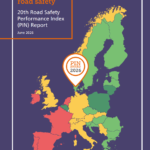
The European Transport Safety Council (ETSC) has released the 20th Annual PIN Report during the 2026 ETSC Road Safety Performance Index Conference which took place in Brussels, on 23 June 2026. According to this Annual PIN Report, in 2025, around 19,500 people were killed on EU roads, only a 2% reduction from 2024. At the halfway point of the 2020-2030 decade in which the EU has pledged to halve road deaths, road deaths are down just 15% from the pre-pandemic 2019 baseline, when a 31% reduction was needed to stay on course. ETSC also presented the PIN Award to Denmark for its long-term road safety performance.

VIAS Institute organized with great success the Annual ESRA Partner Meeting for 2026 hosted by the Belgian Federal Public Service Mobility and Transport, which took place in Brussels, on 22 June 2026. This Event included 34 participants from across Europe, as well as Canada, Japan and Singapore, that exchanged experiences, discussed the latest developments in ESRA4, and explored how road safety data can help shape national policies. NTUA actively contributed with the following presentation:
NTUA actively contributed with the following presentation:

The Hellenic Association for the deployment of Intelligent Transport Systems (ITS Hellas) in cooperation with the I-Sense Group of the Institute of Communications & Computer Systems (ICCS) organized with great success the 11th ITS Hellas Conference which took place in Athens, Greece on 23-24 June 2026, under the theme “Greece on the Move: Smart Transportation of People and Goods Today and Tomorrow“. The Conference focused on current challenges and opportunities in the transportation sector, highlighting the role of Intelligent Transportation Systems in shaping an efficient, safe, and sustainable mobility ecosystem for people and goods. Particular emphasis was also placed on the role of Artificial Intelligence in transportation and mobility, as a catalyst for the development of smarter, more adaptive, and more efficient systems. NTUA actively contributed with the following presentation:
NTUA actively contributed with the following presentation:

The Directorate General for Mobility and Transport (DG MOVE) of the European Commission recently published the third edition of the Sustainable Urban Mobility Planning (SUMP) Guidelines, providing cities across Europe with improved support to plan, develop and implement sustainable urban mobility. The updated SUMP Guidelines are aligned with key frameworks such as the European Green Deal, the Sustainable and Smart Mobility Strategy, the Road Safety Policy Framework, the new EU Urban Mobility Framework, and reflect the requirement under the revised TEN-T Regulation for 431 urban nodes across Europe to adopt a Sustainable Urban Mobility Plan by end 2027. Related to the updated SUMP Guidelines, the SUMP Reference Document on Cycling and the Urban Vehicle Access Regulations were also published.
The Horizon Europe research project TRUST has recently released its 1st Newsletter, providing updates on the first year of activities of the project, which aims to grow a positive Traffic Safety Culture across Europe through a systematic transition towards shared responsibility for safe and sustainable mobility. The Newsletter highlights that TRUST project partners presented at two major road safety conferences: the IRTAD 2026 Conference in Athens and the TRA 2026 Conference in Budapest. It also announces the launch of the first episode of the TRUST Podcast, in which TRUST Advisory Board members discuss traffic safety culture, as well as upcoming pilot activities for testing TRUST interventions in secondary schools, exploring how different approaches can improve Traffic Safety Culture among young people.

The EU funded research project DELPHI organized with great success its Final Event which took place in Athens, Greece on 18 June 2026. This Event brought together transport stakeholders, researchers, policymakers, industry representatives and mobility experts to discuss the future of multimodal, sustainable and intelligent transportation systems, and showcased the main achievements and results of the DELPHI project, highlighting innovative solutions for multimodal freight and passenger transport, AI-enabled traffic and mobility management, data interoperability, sustainable urban logistics, and collaborative transport ecosystems. NTUA actively contributed with the following presentation:
NTUA actively contributed with the following presentation:

The International Association of Public Transport (UITP) organized with great success a Webinar titled “Bus Talks on Network Planning – Buses in 30km/h cities” which took place online, on 9 June 2026. This Event demystified the impacts of 30 km/h measures on bus networks through a combination of academic analysis and real-world operational outcomes. It explored how such environments influence bus performance, including commercial speed, reliability and overall service quality. By bringing together research insights and practical case studies, the discussion highlighted both the challenges and the opportunities that 30 km/h policies create for bus operations across different urban contexts. NTUA actively contributed with the following presentation:
NTUA actively contributed with the following presentation: